
Pesten
Folklore Fact Friday

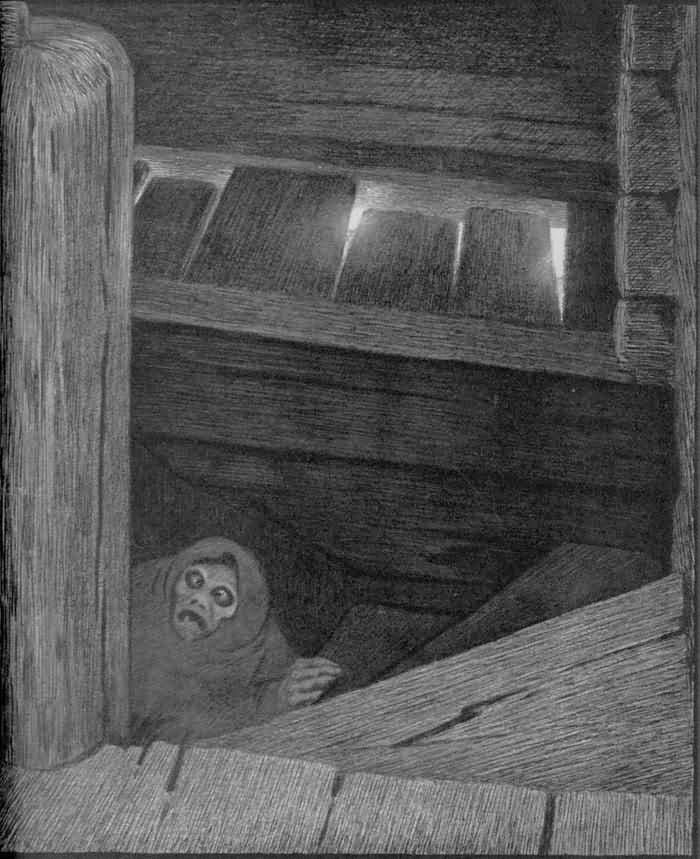
In Swedish folklore, the plague took a tangible form. Sweden lost a third of its population when the Black death swept through the country in the middle of the 14th century. Beyond that, however, several epidemics affected the country during the following centuries, so it’s not surprising that the plague would become alive in folkloric tradition.
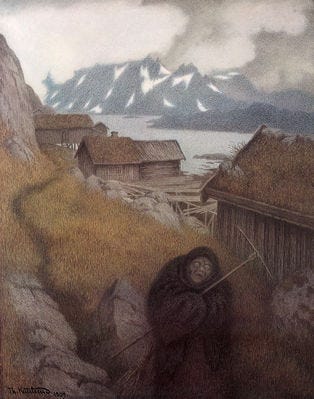
Since disease mechanisms were not understood, the spread and arrival of disease could be interpreted in different ways. For example, one could hang a piece of meat in the open air and, if it turned black overnight, it meant the plague was approaching. The most widespread tradition confers an anthropomorphized form to the plague, as we see in the macabre paintings of Theodor Kittelsen. His paintings represent the Norwegian personification of the plague, known as Pesta. This figure would wander throughout the country carrying a rake or broom, sweeping its way forward. Another common variant in Sweden was that a boy and a girl would appear in town carrying, respectively, a rake and broom. It was thought that if the boy raked, some would survive, but if the girl swept, everyone would die. The plague was also thought to not be able to cross bodies of water, and so could appear as an old woman calling from the shore, asking to be rowed to the other side. There could be a comely woman visiting the town one day, and whoever had interacted or danced with her was sure to die. One story tells of a little girl, small as a doll, who appeared at a farm and asked to stay the night. The mistress of the farm accepted, and for her kindness, she alone was spared from death. Beyond human form, the plague could appear as a red rooster, which walked into a house and announced the death of its inhabitants. It could appear as an object as well, for example in the form of a wheel, which came spinning into town accompanied by small creatures that swept along it; the more they swept, the more people would die.
Unfortunately, a common method to halt the spread of the plague was burying a person alive, of which there is evidence from court records. From a 1712 trial, we have records of one One Kerstin Gudmundsdotter of Tuna who had been “forced into the coffin despite screams and lamentations, after which the lid was nailed shut.” The woman was rescued by people who heard her cries, but this was not always the case. There is a particular legend referring to this practice where some men are digging a grave and lure a passing child into sitting in the dug hole in exchange for a sandwich. They then proceed to bury the child alive, who cries out as his sandwich gets ruined by the dirt. This particular legend motif, however, is part of folk storytelling and not something that was thought to have actually happened. Another common legend-motif is that a village is decimated by the plague and only two people remain, usually a young boy and girl, who nonetheless believe themselves to be alone. They eventually find each other and help repopulate the village by ringing the church bells or sending smoke signals.
In Sweden, various remedies existed to protect oneself from the plague; a folk magic practice was to bind it to a specific tree, often a juniper bush.
Had you ever heard of this kind of motif, the personification of a disease?